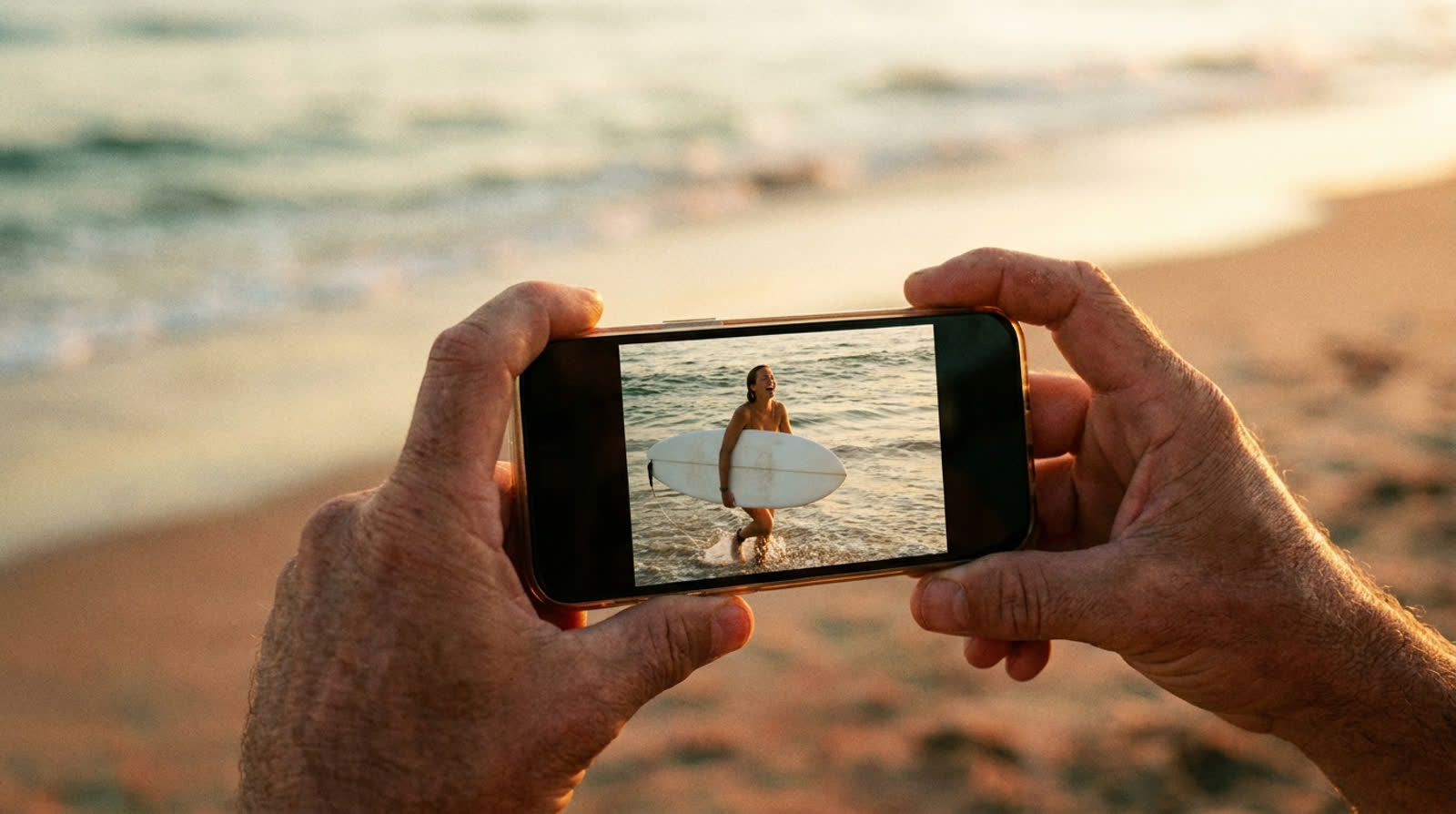
There's one thing in Instagram and Facebook advertising that outweighs your budget, your copy, and the audience you pick: the image. People scroll fast, thumb flying, brain off. Your photo has a fraction of a second to stop them. It either does or it doesn't. And if it doesn't, nobody reads the rest of your ad, no matter how much money you put behind it.
That's not a photographer's opinion. It's what the numbers say, straight from the people who run the ad auctions.
How much the creative actually matters
Three different sources, same direction. Nielsen Catalina Solutions analyzed nearly 500 campaigns to figure out where advertising-driven sales lift comes from: 47% depends on the creative, the biggest single factor. Audience targeting? 9%. Five times less.
Meta itself, through its own data science team, attributes 56% of auction outcomes to creative quality: more than bid, targeting, and placements combined. And a 2025 AppsFlyer report goes as far as estimating that 70-80% of a Meta ad's performance comes down to the strength of the creative, not the budget.
The practical takeaway: if your ads aren't performing, the first place to look isn't the budget and it isn't the audience. It's the images.
Why the perfect sunset doesn't work
The photo of the empty villa at golden hour, beautifully composed, is gorgeous. And invisible. It looks like a postcard, and the brain has seen a thousand postcards: it files them under "advertising" and skips right past. What stops the thumb is something else: a face showing real emotion, a moment that looks stolen rather than staged, a scene the viewer can picture themselves inside.
There's a subtle but decisive difference between "what would I see" and "what would I feel". The villa at sunset answers the first question. The woman coming out of the water laughing after catching her first wave answers the second. People don't buy the place. They buy how they'll feel when they're there.
The checklist for a photo that stops
Before you launch an ad, run the image through five checks. Is there a person in it, and can you see their face? Does it show what I'd feel there, not just what I'd see? Does it look like a real moment or a photo shoot? If it's a video, does the first frame say something on its own, before play is ever pressed? And does it still work small, on a phone screen, without zooming?
If an image fails these checks, it isn't bad. It's built for a different job: it belongs on your website, on the accommodation page, where the viewer has already decided to give you their attention. In an ad, where attention has to be earned, it can't compete.
Video for people who don't know you, photos for people who do
Once you know what to show, the next question always follows: photo or video? The wrong answer is picking one. The right answer depends on who's on the other end, because someone who has never seen you and someone who spent three minutes on your site need two different things.
Cold, on first contact, video almost always wins. The reason is structural before it's statistical: you're not selling a photographable object, you're selling an experience that unfolds over time. The sunrise session, the face of someone catching their first wave, the long dinner table at night: that's a sequence, not a still, and video is the only format that lets a stranger live inside it for fifteen seconds. The benchmarks point the same way: a Segwise analysis of roughly 67,000 Meta ads measured nearly double the click-through rate for video versus static images (1.9% against 1.1%), and aggregated 2025-2026 data shows people pausing an average of 4.7 seconds on video creative versus 1.4 on a static. These are agency analyses, not laws of physics: your own account gives the final verdict. But as a starting point, the direction is clear.
One caveat: video doesn't mean film-school production. For a retreat, the opposite works better: 15-30 seconds, vertical, shot on a phone during a real session. Three rules only. The first frame has to say something by itself, because plenty of people will never press play. The first 3 seconds decide everything, so open on the strongest moment, not on the drone slowly approaching the villa. And captions are mandatory, because a big share of viewers watch with the sound off.
In retargeting, with people who already know you, the hierarchy flips: the photo often wins. The storytelling has already been done; now you just need to reappear at the right moment and remove the last bit of friction. The message is short ("September dates are filling up", "4 spots left") and a static delivers it in a single glance, without asking fifteen seconds from someone who's already half-decided. On warm audiences, statics tend to convert more efficiently and cost less. And here's the reason nobody mentions: you can produce ten statics in the time it takes to make one video, and on the small audiences of retargeting, where the same people see your ads over and over, you need a deck of variations to rotate, not a single masterpiece. The right retargeting photo is different from the cold one: the best moment of the experience plus one concrete element overlaid (the dates, the price, a real line from a review).
The whole scheme in one line: first encounter, video that lets them live the experience; second encounter, photo that reminds and nudges. And every so often, flip it, as a test rather than a rule: a killer static on cold traffic, or a short room-tour video in retargeting, can surprise you. Benchmarks tell you where to start. Your data tells you where to end up.
Creatives wear out. Prepare more than one
Last warning: even the right photo has an expiry date. Meta has measured that after roughly four exposures to the same ad, conversion probability drops sharply, and with an audience as small as a retreat's, that happens fast. A campaign doesn't rest on one beautiful image: it rests on a small library (five or six images and a couple of short videos, with different subjects) to rotate when the signals dip. How to read those signals, and how to tell a tired creative from an exhausted audience, is the subject of our piece on creative fatigue.
What you can do right now
Stop choosing photos for how beautiful they are and start choosing them for how hard they stop the thumb: those are two different qualities. During your next retreat or camp week, spend an hour collecting real moments: faces (with your guests' consent), laughter, hands, effort, dinner tables, plus a couple of 20-second vertical video sequences. That's advertising material no competitor can copy, because it's your atmosphere.
Then assign each piece to its lane: videos to cold audiences, statics with dates and remaining spots to retargeting. And if you don't have material like this today, put it at the top of the list before spending a single euro on ads. With weak creative, the budget doesn't buy customers. It buys confirmation that "ads don't work".
The real work is figuring out which images work for your audience, testing them against each other, and building the library that carries a season of campaigns. If you'd like a second pair of eyes on the photos and formats you're running today, that's exactly what we look at together in a free audit: no pressure, just a clear picture of where your ads stand.
Sources & references
- Nielsen Catalina Solutions · "Five Keys to Advertising Effectiveness" (2017) · https://www.marketingcharts.com/advertising-trends-80662 · Sales lift breakdown: creative 47%, reach 22%, brand 15%, targeting 9%, recency 5%, context 2%. Study of ~500 campaigns.
- Meta (data science team, Performance Marketing Summit 2023, via Logical Position) · https://www.logicalposition.com/blog/creative-velocity-the-meta-ads-strategy-revolutionizing-performance-marketing · 56% of auction outcomes attributable to creative quality; creative fatigue data (conversion drop after ~4 exposures).
- AppsFlyer 2025 report (via Billo) · https://billo.app/blog/meta-ads-best-practices/ · 70-80% of Meta ads performance depends on the creative.
- Meta Business · "High-Quality Creative Increases Ad ROI" (Facebook IQ) · https://www.facebook.com/business/news/insights/high-quality-creative-increases-ad-roi · Primary confirmation of the creative quality/ROI link.
- Segwise · "Static vs. Video Ratio for Meta Ads: Data From 67,000 Ads" (2026) · https://segwise.ai/blog/static-video-ratio-meta-ads · Video CTR ~1.9% vs statics ~1.1%; statics more efficient at direct conversion on warm audiences.
- Stackmatix · "Facebook Video Ads vs Image Ads: Performance Data" (2026) · https://www.stackmatix.com/blog/facebook-video-vs-image-ads-performance-2026 · Average attention 4.7s video vs 1.4s static; video recommended for cold, statics for retargeting.
Want more direct bookings?
Let's look at your site and your bookings together: see if the system fits and what you can improve straight away.
Book your free audit →Keep reading
97% of your website visitors leave. Retargeting is how you bring them back.
And the pixel, that word people keep throwing at you, is just the doorbell that tells you who stopped by.
Read →
The 5 automated emails every retreat should have.
You write them once, over a weekend. Then they work on every contact and every guest, forever, while you do something else.
Read →
AI doesn't recommend whoever has the prettiest website. It recommends whoever gets mentioned most.
How ChatGPT actually picks names when someone asks about a retreat, and the four moves you can make, without being a marketing expert.
Read →